Zenufacture

Landscape Plant Guide · USDA Zone 6b

Plants for a Missouri Backyard

Thirty-eight trees, shrubs, grasses, and groundcovers for this site, with the growing conditions, mature size, and maintenance each one actually needs. The ten from the contractor’s original list are badged Recommended; plants that screen a sightline or hold a slope are badged Privacy and Erosion.

Region St. Charles County, Missouri Hardiness Zone 6b Plants 38 selected Revised August 2026
Recommendedon the contractor’s original list Privacyscreens a sightline Erosionholds soil on a slope Missouri nativenative to this region

Growing in Zone 6b

St. Charles County sits in USDA hardiness zone 6b, where average annual extreme winter lows run between roughly −5°F and 0°F. That is a comfortable, wide-open zone for planting: it accommodates most of the shrubs, grasses, and small trees sold in the region, and the plants on this list are all rated at least one zone colder than the site requires, which is the margin you want for a landscape meant to last decades.

The practical constraints here are not winter cold. They are the soil and the summer. Much of the county is heavy clay that drains slowly and runs neutral to alkaline, so plants needing sharp drainage or acidic conditions — the blue spruce and the holly on this list — need their beds amended and, ideally, raised slightly. Summers are hot and humid, with reliable dry stretches in July and August, so everything here needs consistent water through its first two growing seasons regardless of how drought-tolerant it becomes later. The freeze-thaw swings of a Missouri winter also heave new plantings, which is what mulch is really for.

The growing season runs roughly 185 days, from a last spring frost around April 10–15 to a first fall frost around October 15–20. Fall is the best time to plant woody material — September through late October, while the soil is still warm enough for roots to establish but the top growth has stopped demanding water. Spring, April into May, is the second-best window. Avoid planting shrubs in the heat of July and August unless you are prepared to water them by hand all summer.

Hardiness zone
6b
Winter low
−5 to 0°F
Last spring frost
Apr 10–15
First fall frost
Oct 15–20
Growing season
~185 days
Typical soil
Clay, alkaline
Best time to plant
Sept–Octthen Apr–May

At a glance

PlantMature sizeSunWaterDeerSpacing
Green Giant ArborvitaeThuja standishii × plicata ‘Green Giant’30–40 ft tall × 12–18 ft wideFull sun to part shadeMedium; water well the first two yearsRarely damaged8–10 ft on center for a solid screen
Eastern Red CedarJuniperus virginiana30–40 ft tall × 8–15 ft wideFull sunLow — extremely drought tolerant once establishedRarely damaged10–12 ft on center
Nellie Stevens HollyIlex × ‘Nellie R. Stevens’15–25 ft tall × 8–12 ft wideFull sun to part shadeMediumRarely damaged8–10 ft on center
Spartan JuniperJuniperus chinensis ‘Spartan’15–20 ft tall × 4–5 ft wideFull sunLow; drought tolerantRarely damaged4–5 ft on center for a screen
Sea Green JuniperJuniperus chinensis ‘Sea Green’4–6 ft tall × 6–8 ft wideFull sunLow; needs sharp drainageRarely damaged5 ft on center
Dwarf BoxwoodBuxus sp. — cultivar to be confirmed1–2 ft tall × 2–3 ft widePart shade to full sunMedium; consistentRarely damaged — among the most deer-proof24–30 in. on center
Soft Touch HollyIlex crenata 'Soft Touch'2–3 ft tall × 2–3 ft wideFull sun to part shadeMedium; consistentRarely damaged30 in. on center
Fire Chief ArborvitaeThuja occidentalis 'Congabe'3–4 ft tall × 3–4 ft wideFull sun — color fades in shadeMedium; keep even the first two yearsFrequently damaged36–42 in. on center
Blue Globe SprucePicea pungens 'Globosa'3–5 ft tall × 4–6 ft wideFull sun — 6+ hoursLow once establishedRarely damaged4–5 ft on center
Virginia SweetspireItea virginica2–4 ft tall × 3–5 ft wideFull sun to part shadeMedium to high; tolerates wet groundRarely damaged36 in. on center
Kodiak DiervillaDiervilla — Kodiak® Black / Red3–4 ft tall × 3–4 ft wideFull sun to full shade — unusually adaptableLow once established; drought tolerantRarely damaged36–42 in. on center
FothergillaFothergilla major ‘Mount Airy’4–6 ft tall × 4–5 ft wideFull sun to part shade — sun gives the best fall colourMedium; prefers acidic, well-drained soilRarely damaged4 ft on center
Yuki Cherry Blossom DeutziaDeutzia 'NCDX2'12–24 in. tall × 18–24 in. wideFull sun to part shadeMediumRarely damaged24 in. on center
Japanese SpireaSpiraea japonica2–3 ft tall × 3–4 ft wideFull sun for best color and bloomMedium; very adaptable to clayOccasionally damaged30–36 in. on center
Drift RoseRosa — Drift® series18 in. tall × 30 in. wideFull sun — 6–8 hours, non-negotiableMedium; water at the base, never overheadFrequently damaged24–30 in. on center
Russian SageSalvia yangii3–4 ft tall × 3–4 ft wideFull sunLow once establishedRarely damaged3 ft on center
NinebarkPhysocarpus opulifolius4–6 ft tall × 4–6 ft wideFull sun for best foliage colourLow to medium; very adaptableRarely damaged4–5 ft on center
Arrowwood ViburnumViburnum dentatum6–10 ft tall × 6–10 ft wideFull sun to part shadeMedium; tolerates both wet and dry once establishedRarely damaged6 ft on center for a screen
WinterberryIlex verticillata6–8 ft tall × 6–8 ft wideFull sun to part shade — sun means more berriesMedium to high; tolerates wet groundRarely damaged5–6 ft on center
BeautyberryCallicarpa dichotoma3–4 ft tall × 4–5 ft wideFull sun to part shadeMedium; adaptableRarely damaged4 ft on center
Red ChokeberryAronia arbutifolia ‘Brilliantissima’6–8 ft tall × 3–4 ft wideFull sun to part shadeWide tolerance — wet ground through dry clayRarely damaged4 ft on center
Oakleaf HydrangeaHydrangea quercifolia ‘Alice’6–8 ft tall × 6–8 ft widePart shadeMedium; even moisture, never standing waterOccasionally severely damaged6–8 ft on center
Feather Reed GrassCalamagrostis × acutiflora 'Karl Foerster'4–5 ft tall in flower × 2–3 ft wideFull sun to part sunMedium; tolerates heavy clayRarely damaged24–30 in. on center
Little BluestemSchizachyrium scoparium2–4 ft tall × 18–24 in. wideFull sunLow — deeply drought tolerant once establishedRarely damaged18–24 in. on center
Prairie DropseedSporobolus heterolepis2–3 ft tall in flower × 2–3 ft wideFull sunLow once establishedRarely damaged24–30 in. on center
Siberian IrisIris sibirica2–3 ft tall × 2–3 ft wideFull sun to part shadeMedium to moist; takes a wet low spotRarely damaged2 ft on center
Creeping SedumSedum spurium (Phedimus spurius)3–6 in. tall, spreading 12–18 in.Full sunLow — drought tolerant, needs sharp drainageRarely damaged12 in. on center
Creeping PhloxPhlox subulata4–6 in. tall, spreading 18–24 in.Full sunLow to medium; needs good drainageRarely damaged18 in. on center
Hardy PlumbagoCeratostigma plumbaginoides8–12 in. tall, spreading 12–18 in.Full sun to part shadeMedium; well-drainedRarely damaged12–18 in. on center
Pennsylvania SedgeCarex pensylvanica6–10 in. tall, spreading by rhizomePart shade to full shadeLow once established — a dry-shade specialistRarely damaged12 in. on center
Wild GingerAsarum canadense6–8 in. tall, spreading 12–18 in.Part shade to full shadeMedium; prefers consistent moistureRarely damaged12 in. on center
Eastern RedbudCercis canadensis20–30 ft tall × 25–35 ft wideFull sun to part shadeMedium; adaptable, handles clayRarely damagedSet 20 ft from the house
ServiceberryAmelanchier × grandiflora ‘Autumn Brilliance’15–25 ft tall × 15–20 ft wideFull sun to part shadeMediumOccasionally damagedSet 15 ft from the house
White FringetreeChionanthus virginicus12–20 ft tall × 12–20 ft wideFull sun to part shadeMediumRarely damagedSet 15 ft from the house
Kousa DogwoodCornus kousa20–25 ft tall × 20 ft wideFull sun to part shadeMedium; needs good drainageRarely damagedSet 20 ft from the house
SmoketreeCotinus coggygria ‘Royal Purple’10–15 ft tall × 10–12 ft wideFull sun — the purple washes out in shadeLow; drought tolerant once establishedRarely damagedSet 12 ft from the house
Ozark Witch HazelHamamelis vernalis6–10 ft tall × 8–12 ft wideFull sun to part shadeMedium; tolerates moist ground and low spotsRarely damagedSet 10 ft from the house
Panicle Hydrangea, Tree FormHydrangea paniculata ‘Limelight’6–8 ft tall × 4–6 ft wideFull sun to part shadeMedium to high; thirsty in JulyOccasionally damaged6 ft from anything it should not lean into
Section 01

Privacy & Screening

Plants chosen to block sightlines rather than decorate. Height, density, and how fast they get there matter more here than flowers. The five below run from a 4-foot evergreen mass up to a 40-foot screen, so they can be matched to how much room the property line actually has — width is usually the real constraint, not height. Plants elsewhere in this guide that also screen well are badged Privacy.

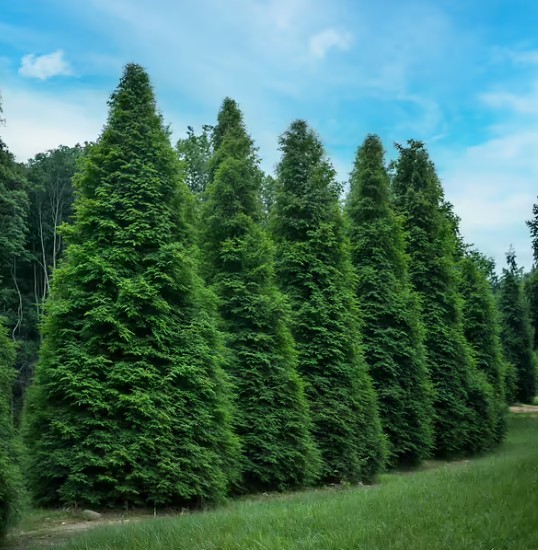
Green Giant Arborvitae in a landscape setting

Green Giant Arborvitae

Privacy

Thuja standishii × plicata ‘Green Giant’

The standard fast privacy screen for this region, and for good reason: it puts on three to five feet a year when young, holds rich green colour through winter, and needs no care at all once rooted. It is also markedly more deer-resistant than the American arborvitae used elsewhere in this guide.

Mature size
30–40 ft tall × 12–18 ft wide
Time to size
10–15 years
Sun
Full sun to part shade
Water
Medium; water well the first two years
Bloom
None — grown as an evergreen screen
Seasonal interest
Dense rich green year-round, holds colour in winter
Deer
Rarely damaged
Growth rate
Very fast — 3–5 ft per year when young
Hardiness
Zones 5–8
Spacing
8–10 ft on center for a solid screen
Maintenance
None required; tolerates shearing
Best use
Fast privacy screen, windbreak, property line
Watch outTwo mistakes are near-universal with this plant. People space them 3–4 ft apart, which looks good for five years and then produces a crowded hedge that thins out at the bottom — 8–10 ft is correct even though it looks sparse at planting. And people forget the width: this is 12–18 ft across at maturity, so it does not belong in a narrow side yard.
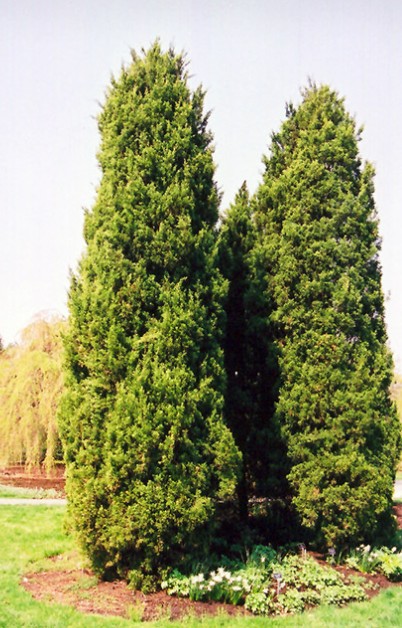
Eastern Red Cedar in a landscape setting

Eastern Red Cedar

PrivacyMissouri native

Juniperus virginiana

The toughest evergreen available here, and a Missouri native — it grows on bare limestone glades where nothing else will. Dense, upright, and completely indifferent to drought, heat, alkaline clay, and wind. Female plants carry frosted blue cones that cedar waxwings and dozens of other birds depend on.

Mature size
30–40 ft tall × 8–15 ft wide
Time to size
15–20 years
Sun
Full sun
Water
Low — extremely drought tolerant once established
Bloom
None; females carry frosted blue cones
Seasonal interest
Evergreen year-round; bronzes slightly in hard winters
Deer
Rarely damaged
Growth rate
Moderate to fast
Hardiness
Zones 2–9
Spacing
10–12 ft on center
Maintenance
None
Best use
Native windbreak, screen, wildlife cover
NoteNative to Missouri and the single best screening plant here for wildlife value.
Watch outIt is the alternate host for cedar-apple rust. The disease does no real harm to the cedar itself but disfigures apples, crabapples, and hawthorns within a few hundred feet. If you or an immediate neighbour grow any of those, pick a different screen.
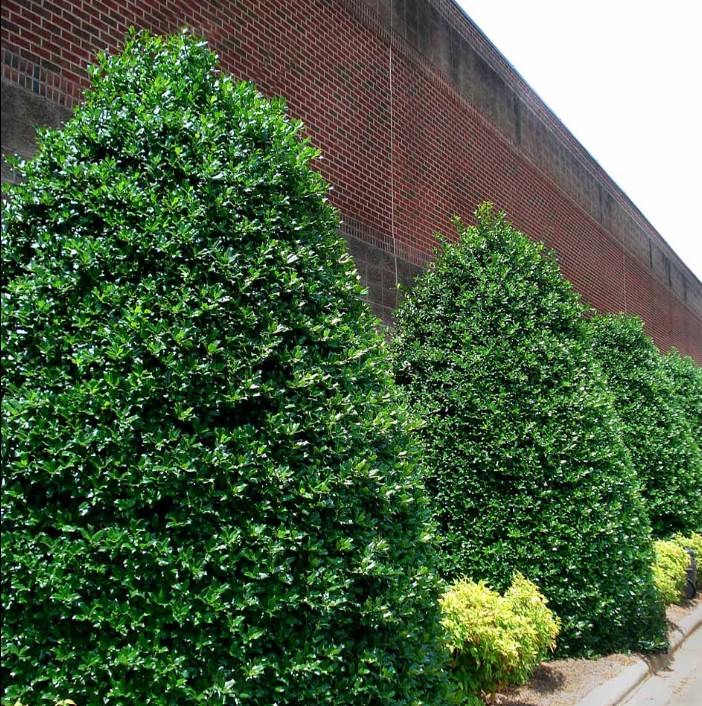
Nellie Stevens Holly in a landscape setting

Nellie Stevens Holly

Privacy

Ilex × ‘Nellie R. Stevens’

A broadleaf evergreen screen with a completely different texture from the conifers — large glossy dark leaves, dense pyramidal habit, and a heavy crop of red berries that holds from October well into March. Fast for a holly, and it fruits without needing a male plant nearby.

Mature size
15–25 ft tall × 8–12 ft wide
Time to size
10–12 years
Sun
Full sun to part shade
Water
Medium
Bloom
Insignificant; grown for evergreen cover and berries
Seasonal interest
Glossy evergreen with heavy red berries, October–March
Deer
Rarely damaged
Growth rate
Fast for a holly — 2–3 ft per year
Hardiness
Zones 6–9
Spacing
8–10 ft on center
Maintenance
Low; shear to shape only if you want a formal line
Best use
Evergreen screen with winter berries, formal or informal
NoteUnlike the winterberry in this guide, it sets fruit on its own — no male pollinator required.
Watch outZone 6 is its cold edge. On an exposed, windy property line a severe winter can burn the foliage. Give it a sheltered aspect rather than the most wind-blasted corner of the lot.
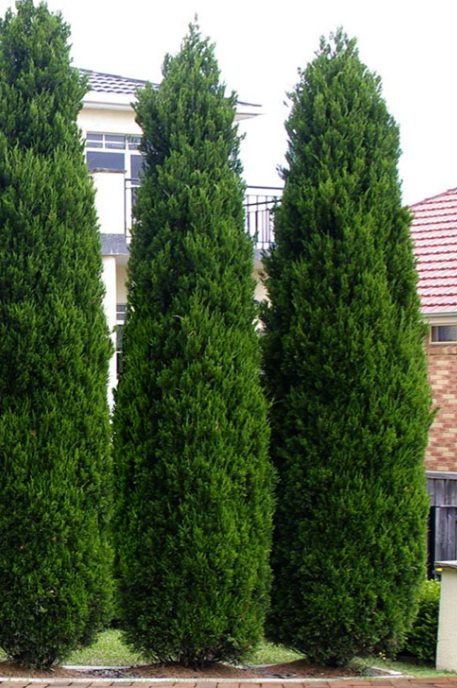
Spartan Juniper in a landscape setting

Spartan Juniper

Privacy

Juniperus chinensis ‘Spartan’

The answer when you need height but have almost no width. A tight, dark green column roughly four feet across at fifteen to twenty feet tall, dense enough to block a view and completely unbothered by drought, heat, or alkaline clay.

Mature size
15–20 ft tall × 4–5 ft wide
Time to size
10–12 years
Sun
Full sun
Water
Low; drought tolerant
Bloom
None — grown as a narrow evergreen screen
Seasonal interest
Dense dark green column year-round
Deer
Rarely damaged
Growth rate
Moderate to fast
Hardiness
Zones 4–9
Spacing
4–5 ft on center for a screen
Maintenance
None
Best use
Narrow screen in a tight side yard, along a fence line
Watch outIts narrowness is the whole point, but it means a single plant screens almost nothing — these work in a row of five or more. The result is a formal, architectural line rather than a soft natural mass, so use it where that reads as deliberate.
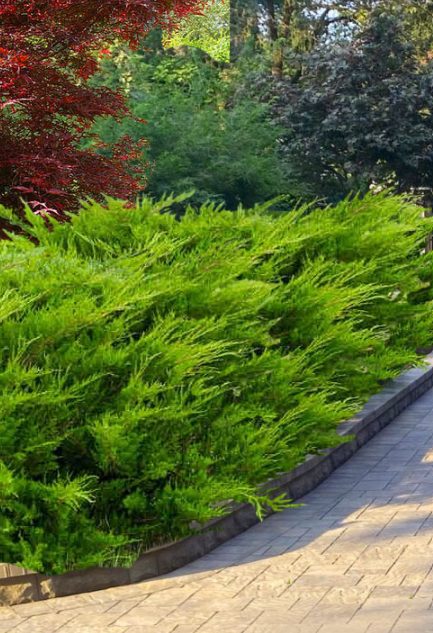
Sea Green Juniper in a landscape setting

Sea Green Juniper

PrivacyErosion

Juniperus chinensis ‘Sea Green’

A mid-height evergreen with arching, fountain-like branches in a soft mint green. It fills the gap between the dwarf foundation evergreens and the tall screens — tall enough to block a seated sightline across a patio, low enough not to wall the yard in.

Mature size
4–6 ft tall × 6–8 ft wide
Time to size
5–7 years
Sun
Full sun
Water
Low; needs sharp drainage
Bloom
None — grown for evergreen mass
Seasonal interest
Arching mint-green foliage, bronzing slightly in winter
Deer
Rarely damaged
Growth rate
Moderate
Hardiness
Zones 4–9
Spacing
5 ft on center
Maintenance
None — never shear it into a ball
Best use
Mid-height evergreen mass, low screen, bank cover
Watch outIt browns out in the interior if it is crowded, shaded, or watered daily by a sprinkler head. Give it full sun, real space, and dry feet, and it will last decades — the tired-looking junipers everywhere are almost always plants that got none of those three.
Section 02

Evergreen Structure

The bones of the planting. These hold their form through winter when everything else is bare, so they carry the beds around the patio and retaining wall year-round. Place these first, then fill between them.

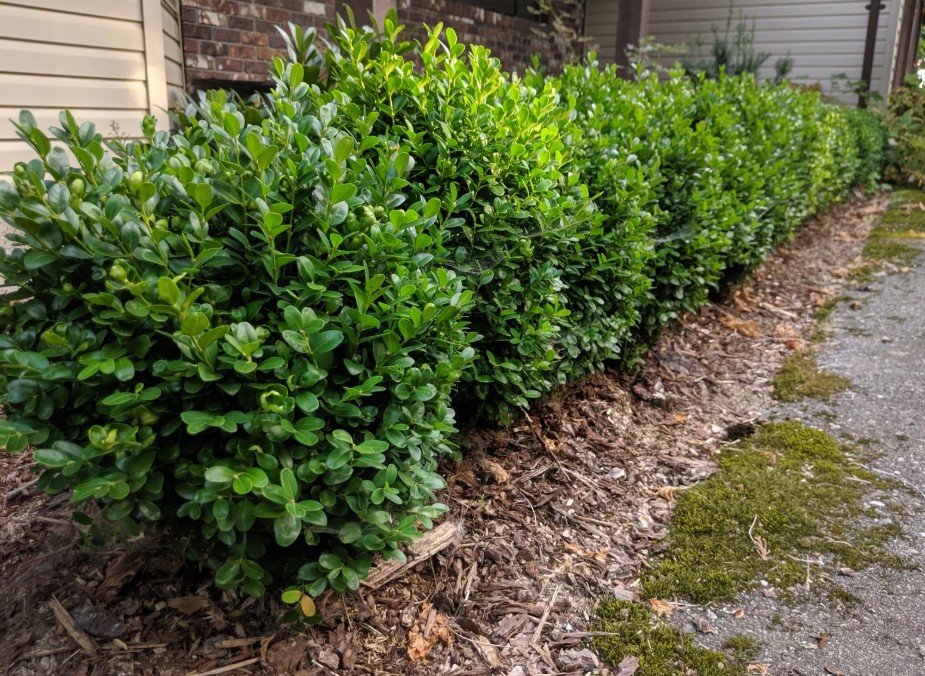
Dwarf Boxwood in a landscape setting

Dwarf Boxwood

Recommended

Buxus sp. — cultivar to be confirmed

The classic formal evergreen. Dense, small-leaved, and shearable into crisp geometry, which is what makes it the standard for edging a patio or holding a clean bed line against masonry. Very slow and very long-lived.

Mature size
1–2 ft tall × 2–3 ft wide
Time to size
10+ years
Sun
Part shade to full sun
Water
Medium; consistent
Bloom
Small and fragrant in early spring — bees work it hard
Seasonal interest
Evergreen structure year-round
Deer
Rarely damaged — among the most deer-proof
Growth rate
Very slow
Hardiness
Zones 5–8
Spacing
24–30 in. on center
Maintenance
Shear late spring; thin the interior for airflow
Best use
Formal edging, foundation, bed definition
Watch outListed by the contractor as “Little Gem boxwood.” ‘Little Gem’ is normally a magnolia cultivar, so confirm which dwarf boxwood he means — most likely ‘Green Gem’ or ‘Wee Willie.’ Give it airflow either way: boxwood blight and leafminer are both present in the region.
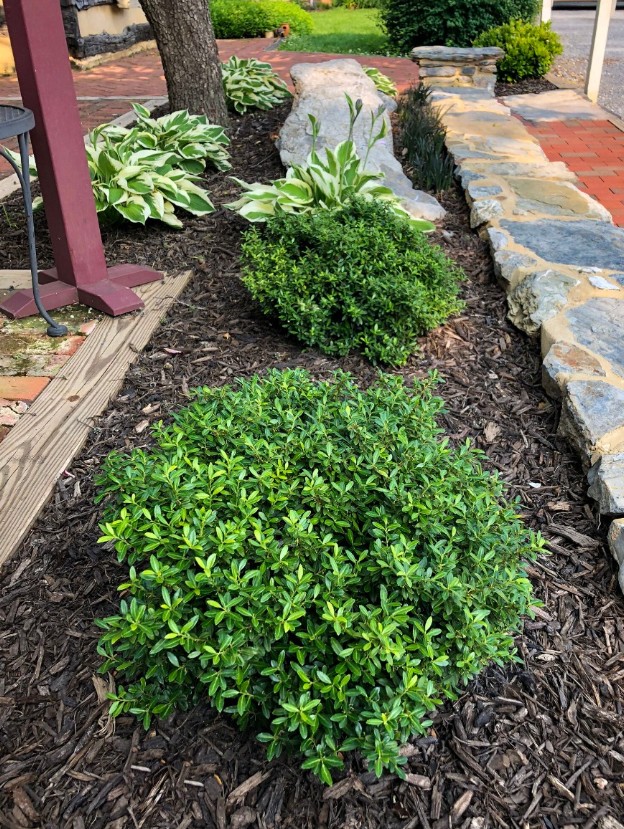
Soft Touch Holly in a landscape setting

Soft Touch Holly

Recommended

Ilex crenata 'Soft Touch'

A low, fine-textured broadleaf evergreen with soft, non-prickly foliage — the name is literal. It reads much like a boxwood but with a looser, more relaxed habit, and it carries no boxwood blight risk.

Mature size
2–3 ft tall × 2–3 ft wide
Time to size
6–8 years
Sun
Full sun to part shade
Water
Medium; consistent
Bloom
Insignificant
Seasonal interest
Evergreen; fine texture year-round
Deer
Rarely damaged
Growth rate
Slow
Hardiness
Zones 5–8
Spacing
30 in. on center
Maintenance
Light shear in spring if shaping
Best use
Low edging, foundation, boxwood alternative
Watch outWants acidic, well-drained soil. Much of St. Charles County runs to alkaline clay, which can cause yellowing (chlorosis). Amend at planting and keep it mulched.
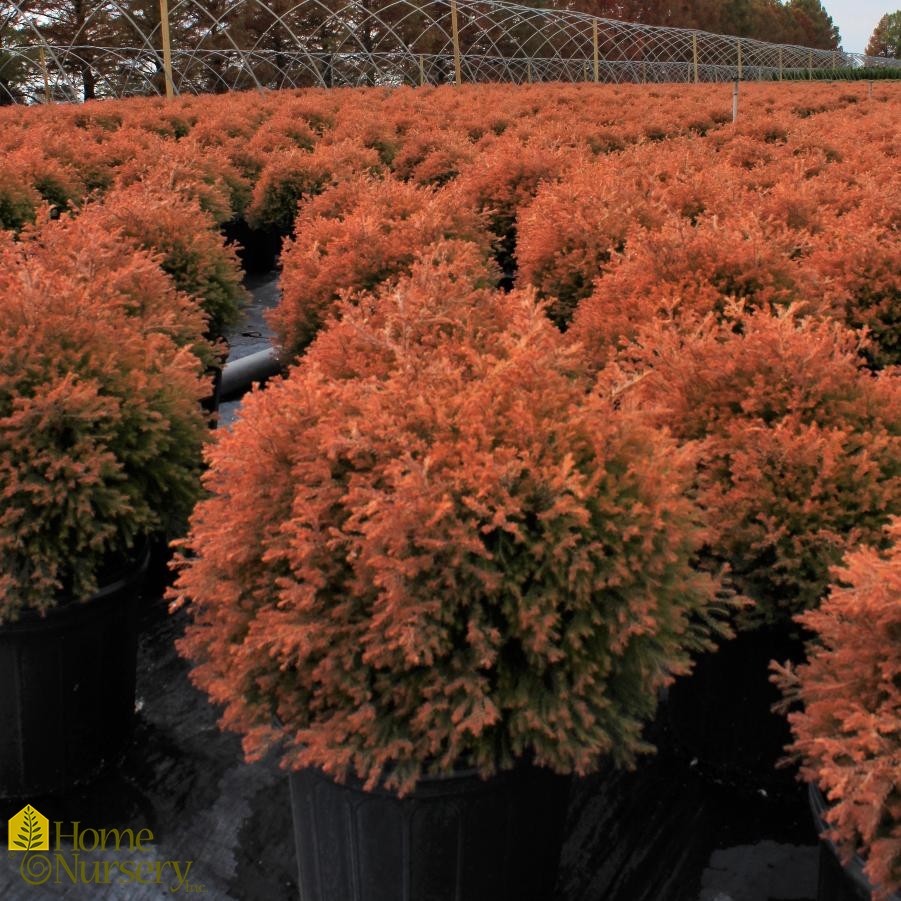
Fire Chief Arborvitae in a landscape setting

Fire Chief Arborvitae

Recommended

Thuja occidentalis 'Congabe'

A tidy globe evergreen that changes color through the year: coral-red new growth in spring, gold-green through summer, deep bronze-red in winter. It gives you evergreen structure without the flat dark green of most conifers.

Mature size
3–4 ft tall × 3–4 ft wide
Time to size
8–10 years
Sun
Full sun — color fades in shade
Water
Medium; keep even the first two years
Bloom
None — grown for foliage color
Seasonal interest
Coral spring, gold summer, bronze winter
Deer
Frequently damaged
Growth rate
Slow to moderate
Hardiness
Zones 5–8
Spacing
36–42 in. on center
Maintenance
Light shaping in spring only
Best use
Foundation, color accent, low informal hedge
Watch outDeer browse arborvitae harder than anything else on this list. With real deer pressure, either site it inside a fenced area or plan on repellent from October through April.
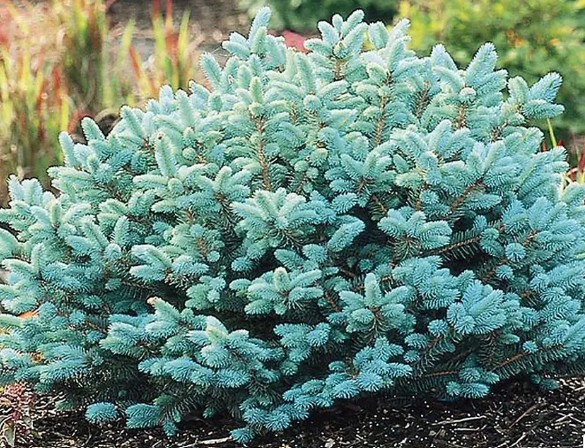
Blue Globe Spruce in a landscape setting

Blue Globe Spruce

Recommended

Picea pungens 'Globosa'

A dense, flat-topped dome of stiff silver-blue needles. It is the strongest color statement available in an evergreen, and it never needs shearing to hold its shape — the globe form is genetic, not pruned. Extremely slow, so buy it close to the size you actually want.

Mature size
3–5 ft tall × 4–6 ft wide
Time to size
10–15 years
Sun
Full sun — 6+ hours
Water
Low once established
Bloom
None — grown for needle color
Seasonal interest
Silver-blue year-round; brightest in winter
Deer
Rarely damaged
Growth rate
Slow — 2–4 in. per year
Hardiness
Zones 2–8
Spacing
4–5 ft on center
Maintenance
Essentially none. Never shear.
Best use
Specimen, foundation anchor, patio corner
Watch outWill not tolerate wet feet. Heavy clay that stays saturated is the single most common way this plant dies in Missouri. Plant it slightly high and amend for drainage.
Section 03

Flowering Shrubs

The seasonal color layer. Staggered bloom times here mean something is flowering from late April through hard frost. These are deciduous and go dormant in winter, which is why the evergreens above have to do the heavy lifting.

Virginia Sweetspire in a landscape setting

Virginia Sweetspire

RecommendedErosionMissouri native

Itea virginica

A Missouri native with fragrant white bottlebrush flowers in late May and June, followed by the best fall color on this list — a deep red-burgundy that holds unusually late in the season. It also tolerates wet soil, which almost nothing else here will do.

Mature size
2–4 ft tall × 3–5 ft wide
Time to size
3–5 years
Sun
Full sun to part shade
Water
Medium to high; tolerates wet ground
Bloom
Fragrant white racemes, late May–June
Seasonal interest
Early summer bloom; brilliant late red fall color
Deer
Rarely damaged
Growth rate
Moderate; suckers into a colony
Hardiness
Zones 5–9
Spacing
36 in. on center
Maintenance
Low; remove suckers to contain, prune after flowering
Best use
Massing, rain garden, downspout outfall, low wet spots
NoteNative to Missouri and a strong pollinator plant. This is the one to put wherever the site drains poorly — a low corner, or the end of a downspout run.
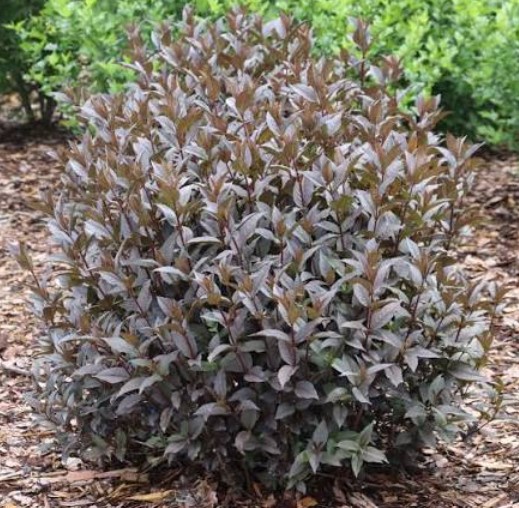
Kodiak Diervilla in a landscape setting

Kodiak Diervilla

RecommendedErosionMissouri native

Diervilla — Kodiak® Black / Red

Probably the toughest plant on the list. It handles full sun to full shade, dry soil, and slopes without complaint. Dark red or near-black new foliage, small yellow tubular flowers through summer, and red fall color. A genuinely low-input shrub.

Mature size
3–4 ft tall × 3–4 ft wide
Time to size
3–4 years
Sun
Full sun to full shade — unusually adaptable
Water
Low once established; drought tolerant
Bloom
Small yellow tubular flowers, June–August
Seasonal interest
Red or black foliage, summer bloom, red fall
Deer
Rarely damaged
Growth rate
Moderate to fast; suckers
Hardiness
Zones 4–8
Spacing
36–42 in. on center
Maintenance
Very low; hard prune in late winter if it needs it
Best use
Massing, slopes and erosion control, dry shade
NoteThe genus is North American native and a good bumblebee plant. The contractor listed “Kodiak Black or Red” — Black has dark purple-black foliage, Red is red-tinged. Pick one for consistency within a mass.
Fothergilla in a landscape setting

Fothergilla

Fothergilla major ‘Mount Airy’

Honey-scented white bottlebrush flowers open in April before the leaves, the summer foliage is a clean blue-green, and then it produces the best fall colour of any shrub in this guide — yellow, orange, and scarlet, frequently all on the same leaf.

Mature size
4–6 ft tall × 4–5 ft wide
Time to size
5–7 years
Sun
Full sun to part shade — sun gives the best fall colour
Water
Medium; prefers acidic, well-drained soil
Bloom
Fragrant white bottlebrushes, April, before the leaves
Seasonal interest
Spring scent, blue-green summer, multicoloured fall
Deer
Rarely damaged
Growth rate
Slow
Hardiness
Zones 4–8
Spacing
4 ft on center
Maintenance
Essentially none
Best use
Mixed border, foundation, beside a walk for the fragrance
Watch outLike the Soft Touch holly, it wants acidic soil and will yellow in the alkaline clay common here. Amend the planting hole and keep it mulched, or it will sulk.
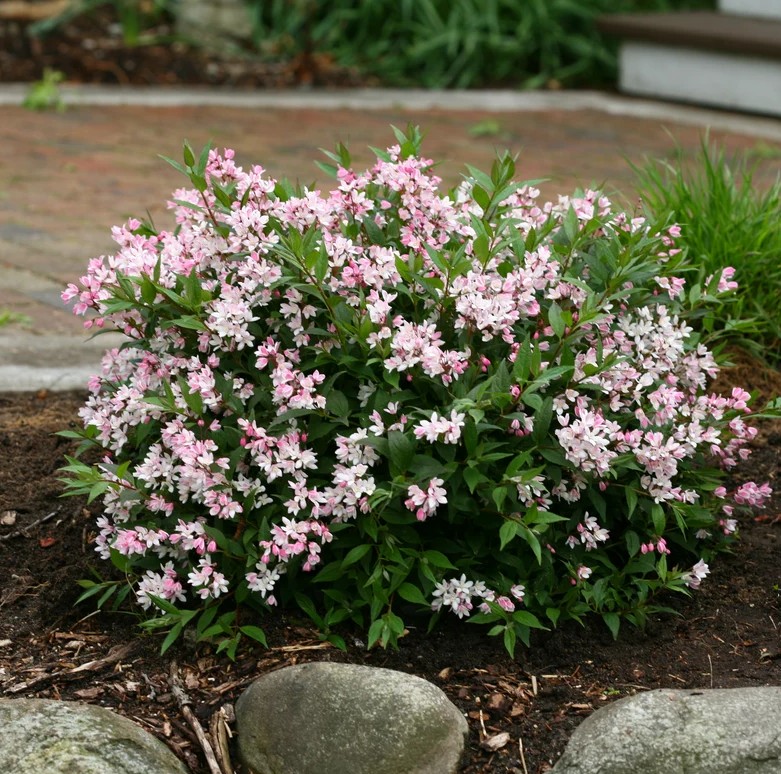
Yuki Cherry Blossom Deutzia in a landscape setting

Yuki Cherry Blossom Deutzia

RecommendedErosion

Deutzia 'NCDX2'

A very low, wide-spreading deciduous shrub that behaves almost like a groundcover. It is covered in small pink-and-white star flowers through late April and May, then turns burgundy-purple in fall. One of the lowest-maintenance plants here.

Mature size
12–24 in. tall × 18–24 in. wide
Time to size
3 years
Sun
Full sun to part shade
Water
Medium
Bloom
Pink and white stars, late April–May
Seasonal interest
Spring bloom; burgundy-purple fall foliage
Deer
Rarely damaged
Growth rate
Moderate
Hardiness
Zones 5–8
Spacing
24 in. on center
Maintenance
Prune only in the weeks right after bloom
Best use
Massing, edging, front of border, slopes
Watch outBlooms on old wood. Pruning in late winter or early spring removes the entire flower display for that year — prune right after flowering or not at all.
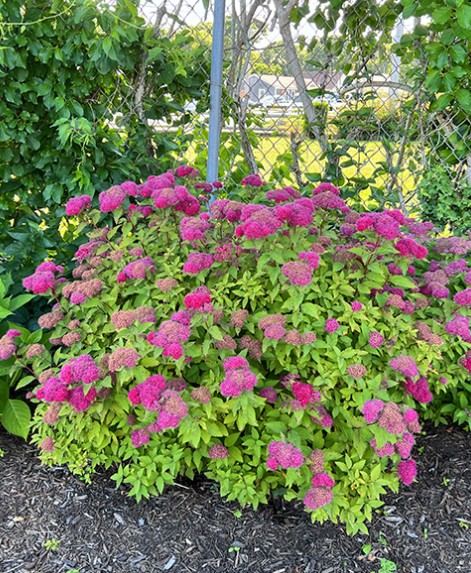
Japanese Spirea in a landscape setting

Japanese Spirea

Recommended

Spiraea japonica

A dependable, fast, low mounding shrub with flat pink flower clusters in June and often a lighter second flush into September. Many cultivars carry chartreuse or gold foliage that holds color all season and finishes orange-red in fall.

Mature size
2–3 ft tall × 3–4 ft wide
Time to size
3–4 years
Sun
Full sun for best color and bloom
Water
Medium; very adaptable to clay
Bloom
Flat pink clusters in June; reblooms if sheared
Seasonal interest
Gold spring foliage, summer bloom, orange fall
Deer
Occasionally damaged
Growth rate
Fast
Hardiness
Zones 4–8
Spacing
30–36 in. on center
Maintenance
Shear lightly after first bloom; hard prune in late winter
Best use
Mass planting, low border, front of foundation
Watch outThe straight species is considered invasive in parts of the eastern U.S. and appears on Missouri watch lists. Specify a modern low-seed or sterile cultivar — Double Play® or ‘Little Princess’ — rather than the species, and confirm which one with the contractor.
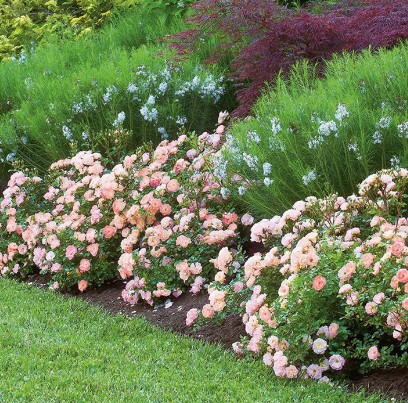
Drift Rose in a landscape setting

Drift Rose

Recommended

Rosa — Drift® series

A low, spreading groundcover rose bred to bloom continuously from late spring until hard frost with almost no care. It is self-cleaning, so no deadheading. Sold in peach, apricot, coral, red, pink, and white — the color is a choice still to be made.

Mature size
18 in. tall × 30 in. wide
Time to size
2–3 years
Sun
Full sun — 6–8 hours, non-negotiable
Water
Medium; water at the base, never overhead
Bloom
Continuous, late May to frost
Seasonal interest
The longest bloom window on this list
Deer
Frequently damaged
Growth rate
Moderate
Hardiness
Zones 4–11
Spacing
24–30 in. on center
Maintenance
Cut back to about 6 in. in late winter
Best use
Front of border, mass along patio or walk, slopes
Watch outRose rosette disease is established in Missouri. Inspect plants at purchase and avoid siting near wild multiflora rose, which is the main reservoir for it.
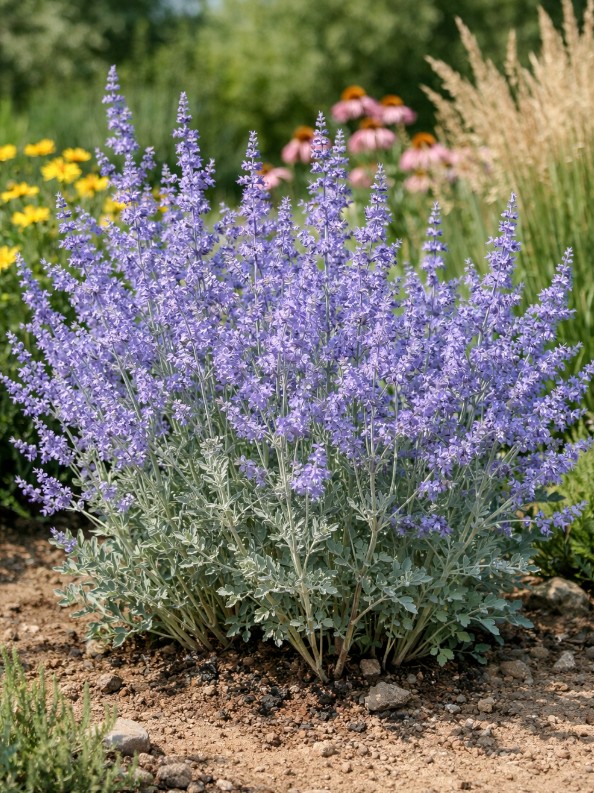
Russian Sage in a landscape setting

Russian Sage

Salvia yangii (formerly Perovskia atriplicifolia)

The longest bloom on this list and the least trouble. Lavender-blue spires open in late June and are still going at first frost, carried on silver, aromatic foliage that looks deliberate even out of flower. It wants the conditions most plants here complain about — hot, bright, and dry — which makes it the right answer beside the retaining wall and along the drive, where reflected heat cooks everything else.

Mature size
3–4 ft tall × 3–4 ft wide
Time to size
2–3 years
Sun
Full sun — six hours minimum
Water
Low once established; will not tolerate wet winter soil
Bloom
Lavender-blue spires, late June through September
Seasonal interest
Silver aromatic foliage all season, pale standing stems in winter
Deer
Rarely damaged — the aromatic foliage is the reason
Growth rate
Fast — full size in two seasons
Hardiness
Zones 4–9
Spacing
3 ft on center
Maintenance
Cut to 6–8 in. in late winter. That is the whole of it.
Best use
Hot dry sun at the wall, along a drive, planted through grasses
Watch outTwo things sink this plant, and both are kindness. Rich soil and afternoon shade make it grow soft and flop open in the middle by August — it genuinely wants the poor, dry spot. And do not cut it back in fall: the woody stems shelter the crown through a Missouri winter, and it is one of the last things in the bed to break dormancy. Bare stems in late April are normal, not a dead plant.
Section 04

Screening & Wildlife Shrubs

Larger shrubs that fill the contractor's open “Shrubs” category. These run bigger than the flowering shrubs above and do a different job: softening the property line, carrying fruit that feeds birds, and — in the case of the winterberry — putting colour into November and December, the two months everything else leaves bare. Three of the six are Missouri natives.

Ninebark in a landscape setting

Ninebark

PrivacyErosionMissouri native

Physocarpus opulifolius

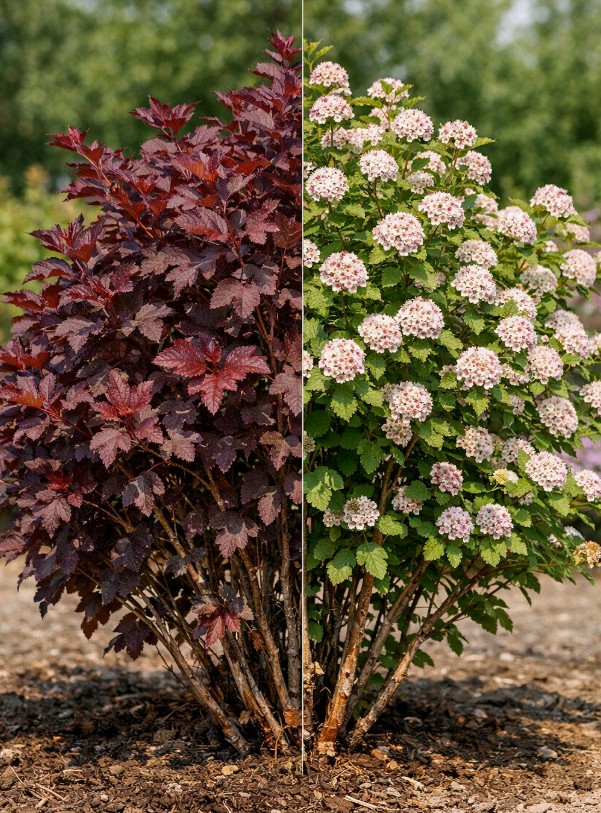
A Missouri native that is close to indestructible — it handles clay, drought, alkalinity, and neglect without complaint. Modern cultivars carry deep burgundy or gold foliage all season, with clusters of white-pink flowers in late spring and papery, peeling bark that gives the plant its name.

Mature size
4–6 ft tall × 4–6 ft wide
Time to size
3–4 years
Sun
Full sun for best foliage colour
Water
Low to medium; very adaptable
Bloom
White to pink clusters, May–June
Seasonal interest
Season-long burgundy or gold foliage, peeling winter bark
Deer
Rarely damaged
Growth rate
Fast
Hardiness
Zones 3–7
Spacing
4–5 ft on center
Maintenance
Low; cut a third of the oldest stems at the base in late winter
Best use
Informal screen, mass planting, difficult dry ground
NoteNative to Missouri. Sized between the flowering shrubs and the trees, which makes it the most useful thing here for softening a property line.
Watch outOlder green-leaved forms get powdery mildew in humid Missouri summers. Specify a modern mildew-resistant cultivar — Summer Wine®, Ginger Wine®, or ‘Little Devil’ for a compact one — rather than the straight species.
Arrowwood Viburnum in a landscape setting

Arrowwood Viburnum

PrivacyErosionMissouri native

Viburnum dentatum

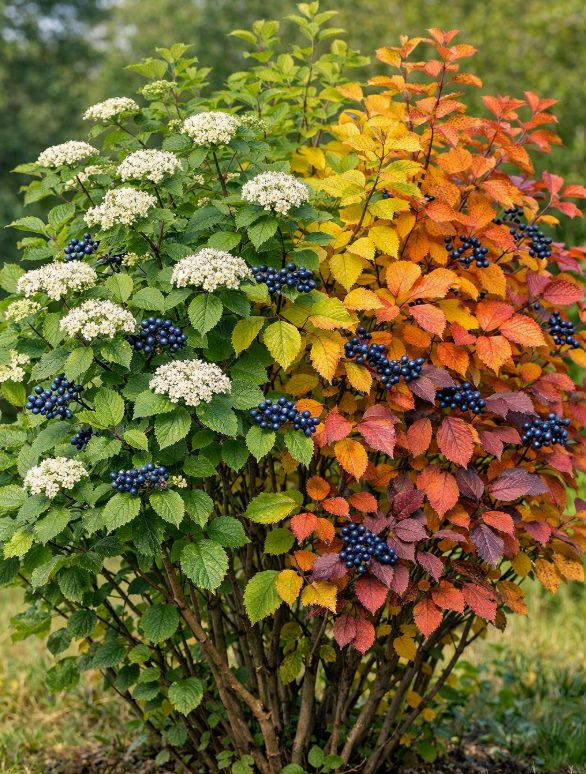
The workhorse screening shrub for this region. A dense, upright Missouri native with glossy foliage, flat white flower clusters in late spring, and blue-black fruit in early fall that birds strip quickly. It takes sun or shade, wet or dry, and asks for essentially nothing.

Mature size
6–10 ft tall × 6–10 ft wide
Time to size
5–7 years
Sun
Full sun to part shade
Water
Medium; tolerates both wet and dry once established
Bloom
Flat white clusters, May–June
Seasonal interest
Spring flower, blue-black fruit, red-purple fall colour
Deer
Rarely damaged
Growth rate
Moderate to fast
Hardiness
Zones 3–8
Spacing
6 ft on center for a screen
Maintenance
Low; renewal-prune older canes in late winter
Best use
Screening, property line, bird planting, informal hedge
NoteNative to Missouri. Fruit set is much heavier with two or more plants, so plant it in groups rather than singly.
Watch outViburnum leaf beetle is established in the region and can defoliate a plant in a bad year. Arrowwood is one of the more susceptible species — check stems for egg scars in winter and prune them out, which is usually all the control needed.
Winterberry in a landscape setting

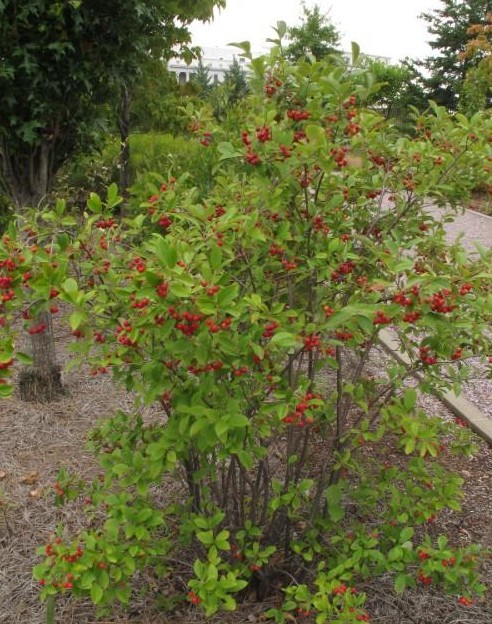
Winterberry

Missouri native

Ilex verticillata

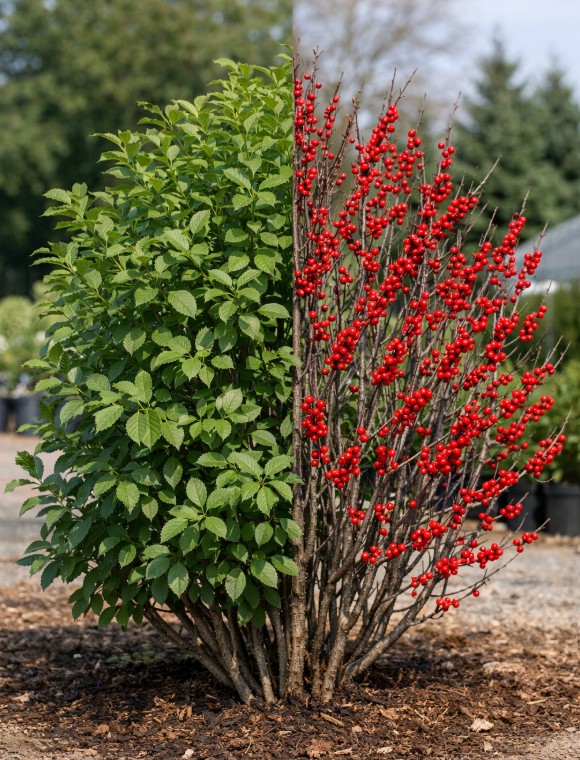
A deciduous native holly grown for one spectacular effect: it drops every leaf in autumn and leaves bare grey stems packed solid with brilliant red berries that hold through December and often into February. It is the single best thing you can plant for winter colour in this region.

Mature size
6–8 ft tall × 6–8 ft wide
Time to size
4–6 years
Sun
Full sun to part shade — sun means more berries
Water
Medium to high; tolerates wet ground
Bloom
Insignificant; grown entirely for fruit
Seasonal interest
Red berries on bare stems, October into February
Deer
Rarely damaged
Growth rate
Moderate; suckers slowly
Hardiness
Zones 3–9
Spacing
5–6 ft on center
Maintenance
Very low; prune in late winter after the show is over
Best use
Winter interest in view of a window, wet spots, bird planting
NoteNative to Missouri. Site it where it is visible from indoors in winter, since that is the only season it does anything.
Watch outMale and female plants are separate, and only females fruit. You must plant one male — ‘Southern Gentleman’ or ‘Jim Dandy’, matched to the female’s bloom time — within about 50 feet of the females, or you will get no berries at all. This is the most common way this plant disappoints people.
Beautyberry in a landscape setting

Beautyberry

Callicarpa dichotoma

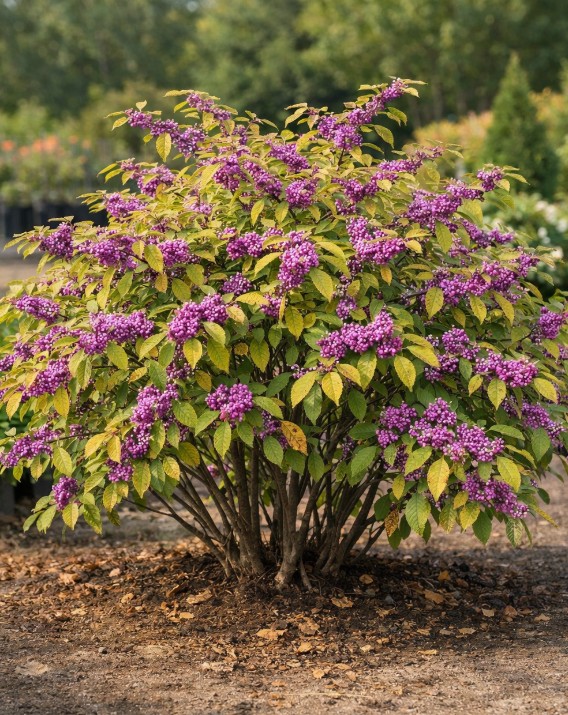
An unremarkable green shrub for most of the year that turns startling in September, when the stems load up with tight clusters of metallic violet berries in a colour nothing else in the garden produces. The berries persist after leaf drop and are eventually taken by birds.

Mature size
3–4 ft tall × 4–5 ft wide
Time to size
2–3 years
Sun
Full sun to part shade
Water
Medium; adaptable
Bloom
Small pink flowers in summer, easily missed
Seasonal interest
Violet berry clusters, September into November
Deer
Rarely damaged
Growth rate
Fast
Hardiness
Zones 5–8
Spacing
4 ft on center
Maintenance
Cut back hard in late winter; it fruits on new wood
Best use
Autumn accent, mixed border, bird planting
NoteAmerican beautyberry (Callicarpa americana) is the species native to southern Missouri and carries larger berry clusters, but it is less reliably hardy through a cold winter this far north. C. dichotoma is the safer choice here; ask the contractor which he can source.
Watch outPrune it hard every late winter, to about a foot. Left alone it becomes leggy and open, and fruit thins out because the berries form on the current season’s growth.
Red Chokeberry in a landscape setting

Red Chokeberry

Erosion

Aronia arbutifolia ‘Brilliantissima’

Three seasons of work from a plant that tolerates almost anything. Clusters of white flowers with pink anthers in May, glossy red fruit from September that hangs into winter, and reliably brilliant scarlet fall foliage. It grows in standing water or in dry clay with equal indifference.

Mature size
6–8 ft tall × 3–4 ft wide
Time to size
4–5 years
Sun
Full sun to part shade
Water
Wide tolerance — wet ground through dry clay
Bloom
White flowers with pink anthers, May
Seasonal interest
Spring flower, red fruit from September, scarlet fall
Deer
Rarely damaged
Growth rate
Moderate; suckers into a colony
Hardiness
Zones 4–9
Spacing
4 ft on center
Maintenance
Low; remove suckers to contain the clump
Best use
Massing, rain garden, wet or dry problem ground
NoteBlack chokeberry (Aronia melanocarpa) is the species native to Missouri and is an equally good plant with dark fruit. Either works; ‘Brilliantissima’ was chosen for its stronger fall colour.
Watch outNaturally leggy and bare at the base as it ages. Plant it in a group of three or more, or set it behind something lower, rather than using it as a stand-alone specimen.
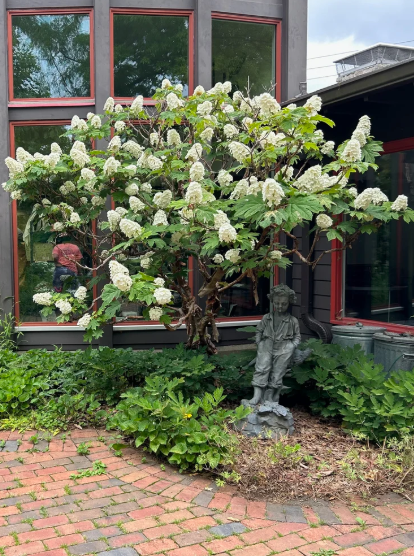
Oakleaf Hydrangea in a landscape setting

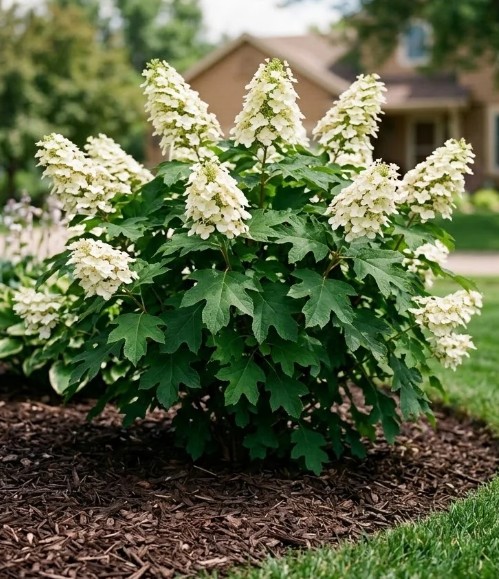
Oakleaf Hydrangea

Erosion

Hydrangea quercifolia ‘Alice’

The only shrub here that earns its place in all four seasons. White conical panicles open in late May and age through pink to tan on the plant; the oak-shaped leaves turn deep burgundy in October and hold late; and when they finally drop the stems show cinnamon bark that peels in sheets. It is also the best large shrub on this list for shade, which is what makes it the answer under the high canopy where the flowering shrubs above would sulk. Native to the southeastern states rather than to Missouri, but thoroughly at home here.

Mature size
6–8 ft tall × 6–8 ft wide
Time to size
6–8 years
Sun
Part shade; morning sun with afternoon shade is ideal
Water
Medium; wants even moisture but not standing water
Bloom
White conical panicles, late May into July, ageing pink then tan
Seasonal interest
Four seasons — bloom, burgundy fall colour, peeling cinnamon bark
Deer
Occasionally severely damaged — protect young plants
Growth rate
Moderate — 1–2 ft per year
Hardiness
Zones 5–9
Spacing
6–8 ft on center
Maintenance
Prune only in the weeks just after flowering, if at all
Best use
Shaded slope, woodland edge, mass under high canopy
Watch outIt sets next year’s flower buds in late summer, so the routine late-winter tidy that suits most of this list removes an entire season of bloom. Prune right after it flowers or leave it alone. Size is the other trap: this is a genuine 8 ft × 8 ft shrub, not a foundation plant, and it is regularly sold in a 3-gallon pot to people with 4 ft of bed. In heavy clay, raise the bed — it wants moisture but drowns in standing water.
Section 05

Ornamental Grasses

Height, movement, and winter texture. Grasses read as soft vertical lines against hard masonry, and they are the one element on this list that visibly responds to wind. The three true grasses want full sun; the Siberian iris that closes the section is not a grass at all, but it holds the same clump of narrow blades from April to frost and takes the wet ground the others refuse. All four are cut back once in late winter, which is the whole of their maintenance. For a grass-like effect in shade, the Pennsylvania sedge in the groundcover section is the better answer.

Feather Reed Grass in a landscape setting

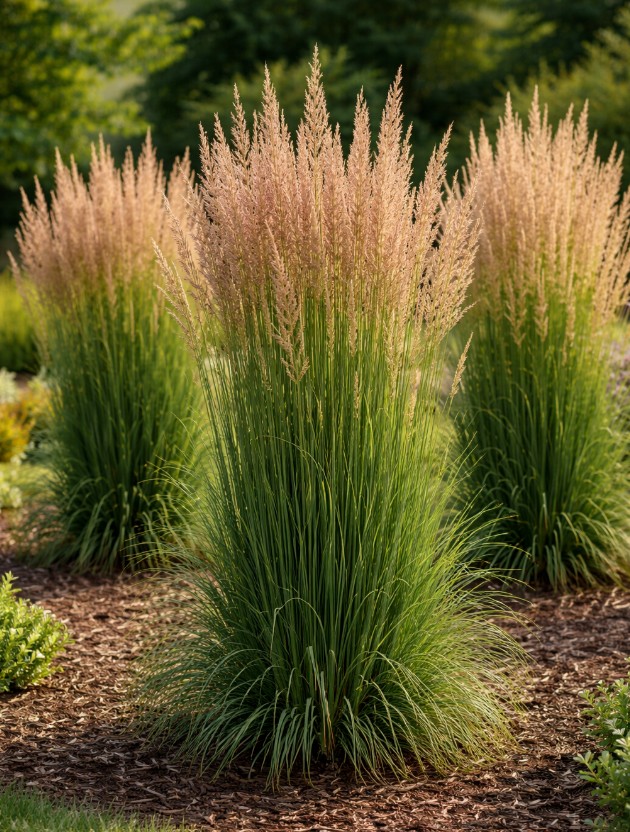
Feather Reed Grass

RecommendedErosion

Calamagrostis × acutiflora 'Karl Foerster'

Strictly upright, narrow plumes that emerge pink-green in June, dry to wheat-tan, and stand through winter snow. It is the standard vertical accent grass for good reason: it does not flop, and unlike most ornamental grasses it is sterile and will not seed around.

Mature size
4–5 ft tall in flower × 2–3 ft wide
Time to size
2–3 years
Sun
Full sun to part sun
Water
Medium; tolerates heavy clay
Bloom
Feathery plumes in June, tan through winter
Seasonal interest
Vertical structure June through February
Deer
Rarely damaged
Growth rate
Fast
Hardiness
Zones 4–9
Spacing
24–30 in. on center
Maintenance
Cut to 4–6 in. in late winter, before new growth starts
Best use
Vertical accent, mass, soft screening near the patio
NoteThe contractor listed this under shrubs, but it is an ornamental grass and needs the late-winter cutback that the shrubs do not. Site it where wind can reach it — that movement is most of the reason to plant it.
Little Bluestem in a landscape setting

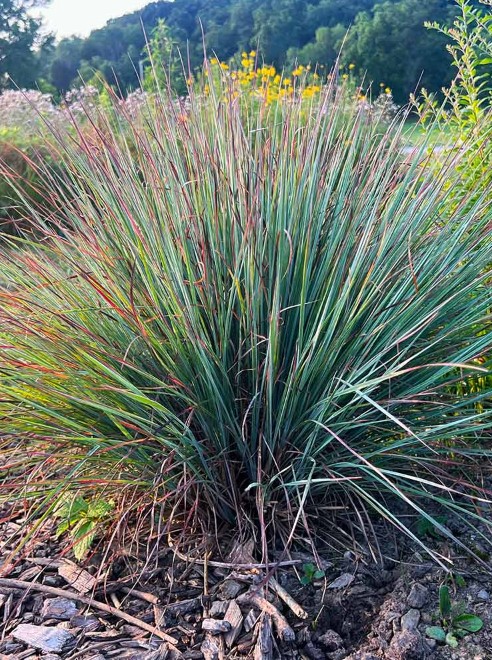
Little Bluestem

ErosionMissouri native

Schizachyrium scoparium

The signature grass of the Missouri prairie, and the best autumn colour of any grass here. Blue-green through summer, then it turns deep copper and mahogany in September and holds that colour, standing upright, straight through winter. Fluffy silver seed tufts catch low light along the stems.

Mature size
2–4 ft tall × 18–24 in. wide
Time to size
2 years
Sun
Full sun
Water
Low — deeply drought tolerant once established
Bloom
Silver-white seed tufts, August–September
Seasonal interest
Blue-green summer, copper autumn, standing colour all winter
Deer
Rarely damaged
Growth rate
Moderate
Hardiness
Zones 3–9
Spacing
18–24 in. on center
Maintenance
Cut to 4–6 in. in late winter
Best use
Massing, slopes, hot dry ground, prairie-style planting
NoteNative to Missouri, and its roots run several feet deep — which is why it carries the erosion badge. It is also a larval host for several skipper butterflies.
Watch outIn rich soil, part shade, or with regular water it flops open in the middle and looks terrible. This is a prairie plant that wants lean, dry ground and full sun — do not amend the soil, do not fertilise, and do not irrigate it once it is established. Cultivars ‘Standing Ovation’ and ‘Blue Heaven’ hold upright better than the straight species.
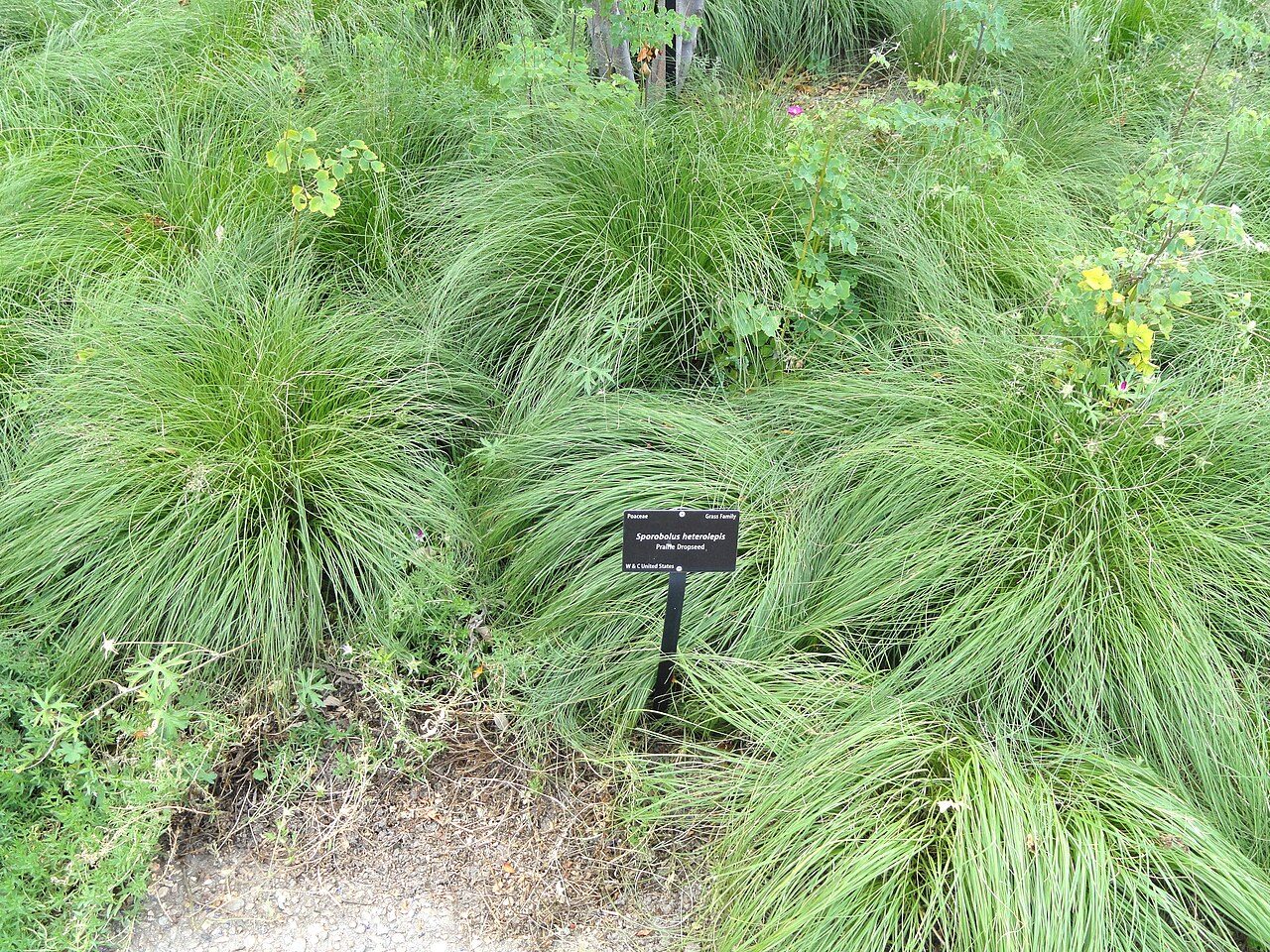
Prairie Dropseed in a landscape setting

Prairie Dropseed

ErosionMissouri native

Sporobolus heterolepis

The most refined native grass available here. It forms a fine-textured emerald fountain, arching neatly rather than standing stiff, and turns gold-orange in autumn. In late summer the airy flower panicles carry a distinct scent that people variously describe as coriander or buttered popcorn.

Mature size
2–3 ft tall in flower × 2–3 ft wide
Time to size
3–4 years
Sun
Full sun
Water
Low once established
Bloom
Airy scented panicles, August–September
Seasonal interest
Fine emerald fountain, gold-orange fall, light tan winter
Deer
Rarely damaged
Growth rate
Slow
Hardiness
Zones 3–9
Spacing
24–30 in. on center
Maintenance
Cut back in late winter
Best use
Edging along a walk or patio, massing, refined native planting
NoteNative to Missouri. Plant it along the edge of the patio or a walk, close enough that the late-summer scent is actually noticed — that is most of the reason to choose it over other grasses.
Watch outGenuinely slow — it can take three or four years to make the fountain shape it is bought for, and a one-gallon plant looks like very little in year one. Buy the largest size you can, or plan to be patient.
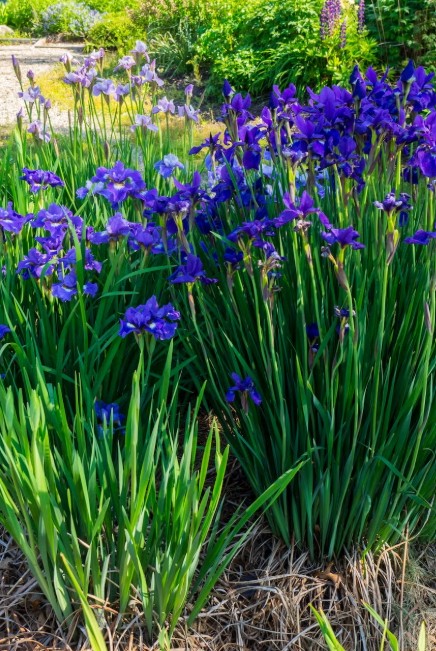
Siberian Iris in a landscape setting

Siberian Iris

Erosion

Iris sibirica

Not a grass, but it does the same job for eleven months of the year: a tight fountain of narrow blades, two to three feet of it, holding its shape from April to hard frost. For a fortnight in late May it does something the grasses cannot, and throws blue-violet flowers well clear of the foliage. It is also the one plant in this section that will take a wet low spot — the fibrous root mass that lets it hold a streambank is exactly what the other three refuse to grow.

Mature size
2–3 ft tall × 2–3 ft wide
Time to size
3 years to a full clump
Sun
Full sun to part shade
Water
Medium to moist; tolerates seasonal standing water
Bloom
Blue-violet, late May into June, held above the foliage
Seasonal interest
Upright grass-like clump April to frost; seed pods hold into winter
Deer
Rarely damaged
Growth rate
Moderate — a full clump by the third year
Hardiness
Zones 3–8
Spacing
2 ft on center
Maintenance
Cut back once in late winter with the grasses; divide every 4–5 years
Best use
Rain garden, downspout outfall, low wet corner, bed edge
Watch outIt is a Siberian iris, not a bearded one, and the two are planted differently: the bearded rhizome bakes on the surface in dry ground, while this one goes an inch under and wants moisture all summer. Sited high and dry it will live and never really thrive. Buy it for the foliage — the bloom is genuinely lovely and genuinely brief, and a plant bought for two weeks in May will disappoint for the other fifty.
Section 06

Groundcover

The living mulch layer. These fill the ground between and beneath the shrubs, hold soil on slopes, and cut down the weeding and re-mulching that open beds demand every spring. All five are deer-resistant and effectively maintenance-free once established, and they are chosen to cover a range of conditions — hot dry sun at the wall, dry shade under trees, and moist shade on the north side.

Using these on a slopeA plant list on its own does not fix an active erosion problem, and planting into a washing bank usually just loses the plants. Three things have to work together: water is routed so it is not sheeting across the slope in the first place, the surface is held for the first two seasons by mulch or an erosion-control blanket, and only then do roots take over. The badged groundcovers handle surface wash by forming dense mats; the badged shrubs — sweetspire, diervilla, ninebark, arrowwood viburnum, chokeberry — sucker and root deeper, and are what actually hold a bank against slumping. On anything steeper than about 3:1, use both layers together rather than either alone.
Creeping Sedum in a landscape setting

Creeping Sedum

Erosion

Sedum spurium (Phedimus spurius)

A succulent mat of thick scalloped leaves that spills over stone and asks for nothing. It thrives exactly where soil is thinnest and hottest — the top of a retaining wall, the strip beside a patio — and turns bronze-red as the weather cools. Cultivars run from deep burgundy (‘Dragon’s Blood’) to bright green (‘John Creech’).

Mature size
3–6 in. tall, spreading 12–18 in.
Time to size
2 years
Sun
Full sun
Water
Low — drought tolerant, needs sharp drainage
Bloom
Rose-pink star clusters, July–August
Seasonal interest
Bronze-red foliage in fall and winter; semi-evergreen
Deer
Rarely damaged
Growth rate
Moderate; roots as it spreads
Hardiness
Zones 3–9
Spacing
12 in. on center
Maintenance
Essentially none; shear if it gets ratty
Best use
Spilling over the retaining wall, hot dry edges, between pavers
Watch outThe one thing it will not survive is wet feet. In heavy clay or a shaded low spot it rots. Give it the driest, sunniest, sharpest-draining ground on the property and it will outlive everything around it.
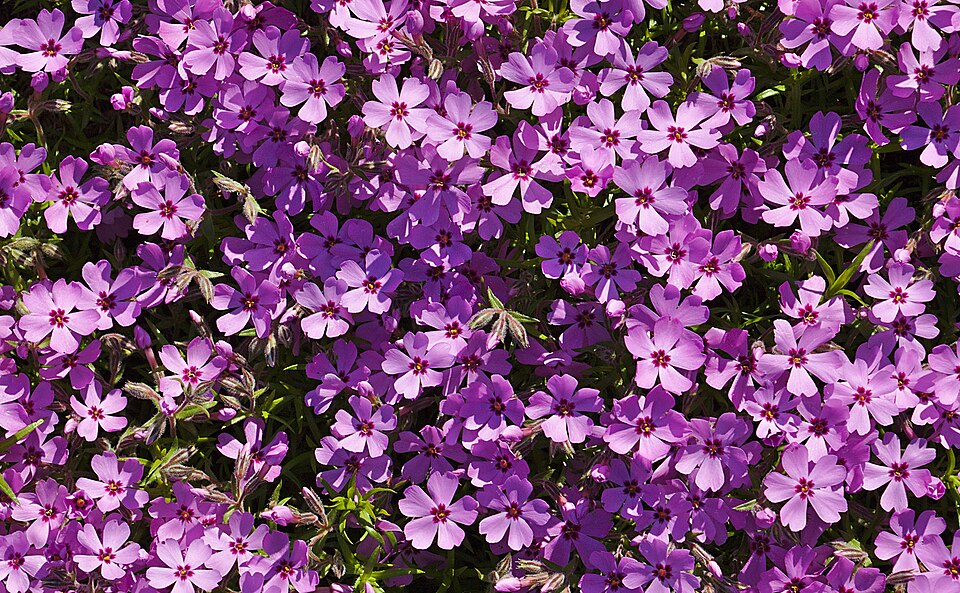
Creeping Phlox in a landscape setting

Creeping Phlox

Erosion

Phlox subulata

For about three weeks in April this disappears entirely under a solid sheet of flowers — pink, lavender, magenta, or white depending on cultivar. The rest of the year it is a low, dense, needle-textured mat. Nothing else here makes a comparable spring statement for the space it takes up.

Mature size
4–6 in. tall, spreading 18–24 in.
Time to size
2–3 years
Sun
Full sun
Water
Low to medium; needs good drainage
Bloom
Solid carpet of bloom, April into early May
Seasonal interest
Spectacular spring bloom; semi-evergreen foliage otherwise
Deer
Rarely damaged
Growth rate
Moderate
Hardiness
Zones 3–8
Spacing
18 in. on center
Maintenance
Shear back by a third right after bloom to keep it dense
Best use
Cascading over wall faces, slopes, front edging
NoteNative to eastern and central North America, and a useful early nectar source when little else is open.
Watch outThe bloom is brief — roughly three weeks. Plant it where that spring moment counts, and pair it with something that carries later color rather than relying on it all season.
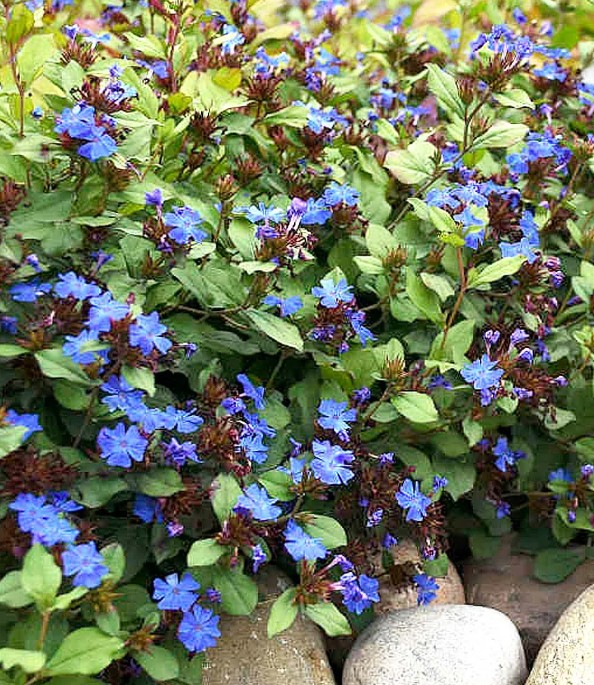
Hardy Plumbago in a landscape setting

Hardy Plumbago

Ceratostigma plumbaginoides

Also sold as leadwort. It produces a true gentian blue — genuinely rare among garden plants — from August until frost, at the exact point in the season when everything else has finished. Better still, the foliage turns bronze-red while the blue flowers are still open, so you get both at once.

Mature size
8–12 in. tall, spreading 12–18 in.
Time to size
2–3 years
Sun
Full sun to part shade
Water
Medium; well-drained
Bloom
Gentian-blue, August through October
Seasonal interest
Late blue bloom over bronze-red fall foliage, at the same time
Deer
Rarely damaged
Growth rate
Moderate; spreads by underground stems
Hardiness
Zones 5–9
Spacing
12–18 in. on center
Maintenance
Cut back in late winter
Best use
Front edging, under shrubs, along the walk
NoteThis is the plant that fills the late-season gap. From August into October it is the only thing on this list still flowering.
Watch outIt emerges very late — often not showing until May, weeks after everything else. Mark its location in fall so nobody digs it up in April assuming it died over winter.
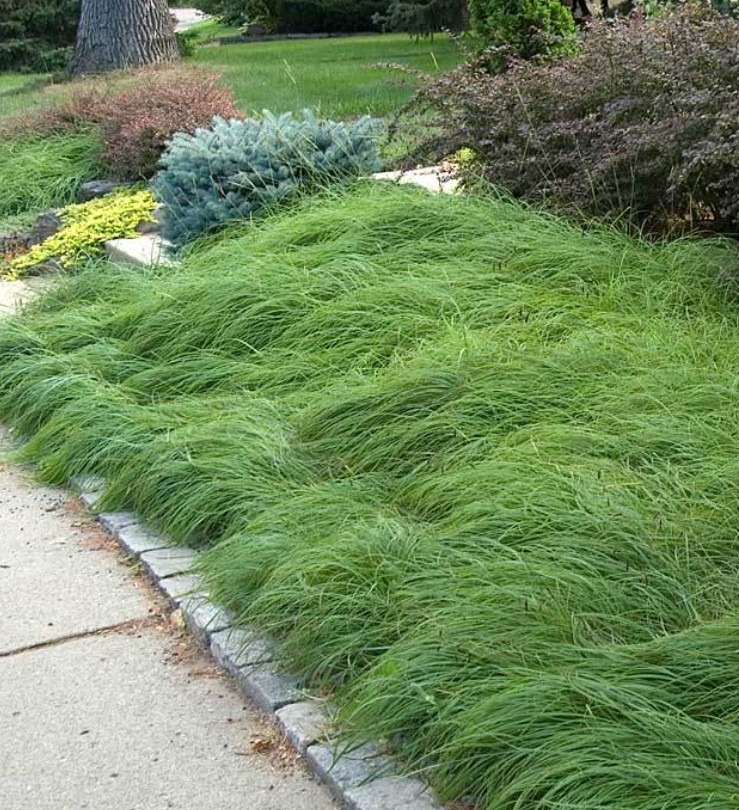
Pennsylvania Sedge in a landscape setting

Pennsylvania Sedge

ErosionMissouri native

Carex pensylvanica

A fine-textured Missouri native that forms a soft, slightly tousled carpet in exactly the place most groundcovers fail: dry shade under established trees. It reads like an unmown lawn, needs no irrigation once rooted, and can be mown once a year or simply left alone.

Mature size
6–10 in. tall, spreading by rhizome
Time to size
3 years
Sun
Part shade to full shade
Water
Low once established — a dry-shade specialist
Bloom
Insignificant
Seasonal interest
Soft green through the season, tan in winter; semi-evergreen
Deer
Rarely damaged
Growth rate
Slow to moderate; forms a colony
Hardiness
Zones 3–8
Spacing
12 in. on center
Maintenance
Optional single mow or shear in early spring
Best use
Lawn alternative under trees, dry shade, naturalized edges
NoteDry shade under a mature tree is the hardest site in any yard — too dark for turf, too root-filled to dig. This is the standard answer to it, and it is native here.
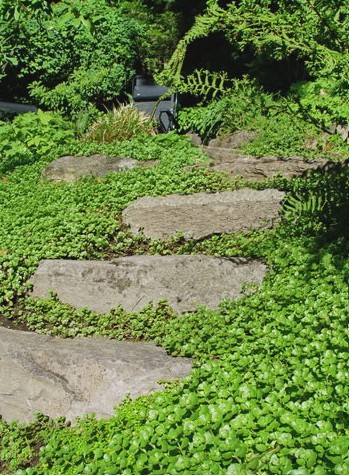
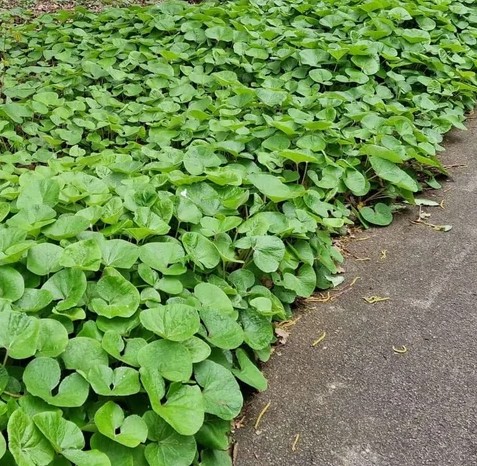
Wild Ginger in a landscape setting

Wild Ginger

ErosionMissouri native

Asarum canadense

A Missouri native woodland groundcover with overlapping heart-shaped leaves that build into a solid, lush green carpet in deep shade. The maroon jug-shaped flowers sit hidden at ground level in April and are mostly a curiosity — the foliage is the reason to plant it.

Mature size
6–8 in. tall, spreading 12–18 in.
Time to size
3–4 years
Sun
Part shade to full shade
Water
Medium; prefers consistent moisture
Bloom
Curious maroon flowers at ground level, April
Seasonal interest
Lush heart-shaped foliage, April through October
Deer
Rarely damaged
Growth rate
Slow; knits into a solid colony
Hardiness
Zones 3–8
Spacing
12 in. on center
Maintenance
None
Best use
Full shade under trees, north side of the house, woodland edge
NoteNative to Missouri. Slow to fill at first, then effectively permanent and weed-proof once it knits together.
Watch outFully deciduous — it disappears completely from November to April. Do not use it anywhere that needs to look covered in winter.
Also considered

Deliberately left off

Several groundcovers sold routinely at garden centers in this region are invasive in Missouri or fail here for other reasons. They were considered and excluded, and are listed so the omission reads as a decision rather than an oversight.

PlantWhy it was excluded
WintercreeperEuonymus fortuneiListed as invasive in Missouri. Escapes into woodland and climbs trees.
Common PeriwinkleVinca minorInvasive in Missouri. Forms dense mats that displace the native woodland groundlayer.
English IvyHedera helixInvasive, and it damages tree bark and mortar joints — a poor neighbor for a new retaining wall.
Japanese PachysandraPachysandra terminalisBrowsed by deer more than its reputation suggests, and prone to Volutella blight in humid Missouri summers.
Creeping JennyLysimachia nummulariaSpreads aggressively into lawn and beds, and is very hard to remove once it is established.
Section 07

Ornamental Trees

The canopy layer, and the element to settle first on site even though it reads last here. Everything above is sized and sited around how much sun these eventually cast, so their mature spread is the most consequential number in this document. All seven stay small enough for a residential lot — none exceeds about 30 feet — and all seven earn their place across more than one season.

Deer and young treesEvery tree here is rated deer-resistant, but that rating is about browsing, not bucks. From September through November, bucks rub their antlers on smooth young trunks and can girdle a new tree in a single night regardless of how unpalatable its leaves are. Put a trunk guard or a ring of stakes on every one of these for the first three to five years. It is the cheapest insurance in the whole project.
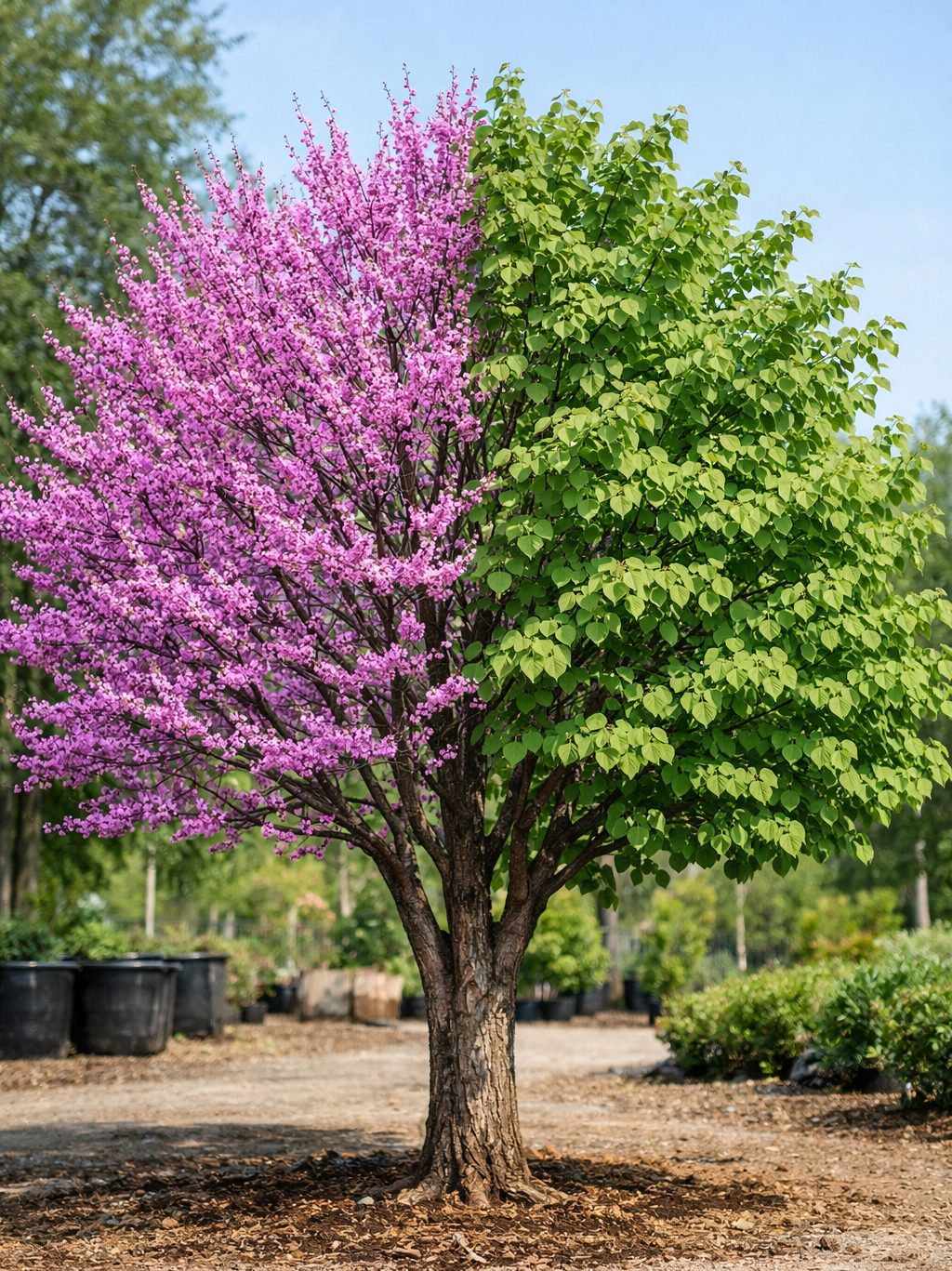
Eastern Redbud in a landscape setting

Eastern Redbud

Missouri native

Cercis canadensis

Missouri’s state tree, and the most recognizable spring event in the region. Magenta-pink flowers open directly on the bare branches and even on the trunk itself — before any leaves appear — then give way to clean heart-shaped foliage. It is native, tolerant of clay, and thrives in the part shade at a woodland edge.

Mature size
20–30 ft tall × 25–35 ft wide
Time to size
15–20 years
Sun
Full sun to part shade
Water
Medium; adaptable, handles clay
Bloom
Magenta-pink on bare wood, late March–April
Seasonal interest
Spring bloom, heart-shaped leaves, clear yellow fall
Deer
Rarely damaged
Growth rate
Moderate
Hardiness
Zones 4–9
Spacing
Set 20 ft from the house
Maintenance
Prune deadwood only, in summer after bloom
Best use
Specimen near the patio, understory, woodland edge
NoteNative to Missouri and the state tree. Cultivars worth asking about: ‘Forest Pansy’ (purple foliage), ‘Rising Sun’ (gold and orange new growth), ‘Ruby Falls’ (weeping, for tight spots).
Watch outRelatively short-lived for a tree — 30 to 50 years — and prone to splitting where two trunks meet at a narrow angle. Buy a single-leader tree with wide branch angles and it will do far better.
Serviceberry in a landscape setting

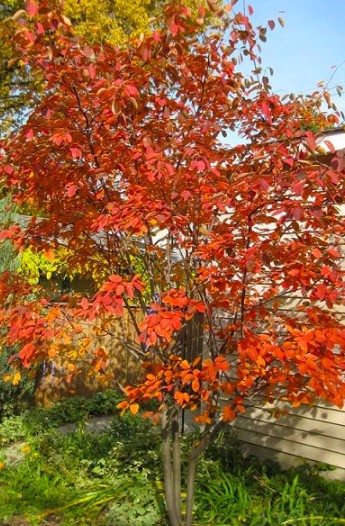
Serviceberry

Amelanchier × grandiflora ‘Autumn Brilliance’

The best four-season small tree available here, and it is not close. White star flowers in April, edible purple berries in June, genuinely brilliant orange-red fall color, and smooth silver-gray bark that carries the winter. Sold as either a multi-stem clump or a single-trunk tree.

Mature size
15–25 ft tall × 15–20 ft wide
Time to size
10–15 years
Sun
Full sun to part shade
Water
Medium
Bloom
White star flowers, April
Seasonal interest
Flowers, June berries, orange-red fall, silver winter bark
Deer
Occasionally damaged
Growth rate
Moderate
Hardiness
Zones 4–9
Spacing
Set 15 ft from the house
Maintenance
Low; decide multi-stem or single-leader at purchase
Best use
Specimen, patio tree, bird planting
NoteThe genus is native to Missouri. Berries taste like a mild blueberry, though birds generally reach them first — which is part of the appeal.
White Fringetree in a landscape setting

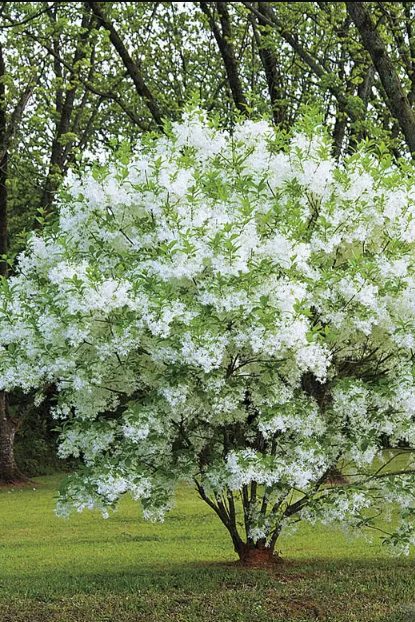
White Fringetree

Missouri native

Chionanthus virginicus

A Missouri native that is badly underused. In late May it covers itself in drooping, fleecy white panicles with a clean sweet fragrance, unlike anything else blooming at that moment, then turns clear yellow in fall. It blooms in the gap between the serviceberry and the kousa dogwood.

Mature size
12–20 ft tall × 12–20 ft wide
Time to size
15–20 years
Sun
Full sun to part shade
Water
Medium
Bloom
Fleecy fragrant white panicles, late May–June
Seasonal interest
Late spring bloom and scent; clear yellow fall
Deer
Rarely damaged
Growth rate
Slow
Hardiness
Zones 3–9
Spacing
Set 15 ft from the house
Maintenance
Very low
Best use
Specimen beside a patio or walk, where the scent is noticed
NoteNative to Missouri. Male plants flower more showily; females carry blue fruit that birds take.
Watch outSlow, and usually sold small — expect several years before it looks like much. Worth knowing too that emerald ash borer has been recorded attacking fringetree, which is in the same family as ash. It remains uncommon, but it is not a zero risk.
Kousa Dogwood in a landscape setting

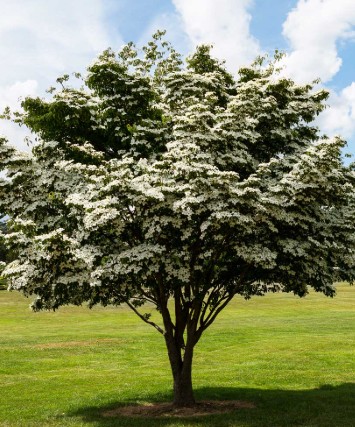
Kousa Dogwood

Cornus kousa

Broad, distinctly horizontal branching that layers as it matures, covered in creamy white bracts for nearly a month in early summer. Unlike the native flowering dogwood, it blooms after the leaves emerge, so the flowers sit above a green background. Older trees develop beautifully mottled, exfoliating bark.

Mature size
20–25 ft tall × 20 ft wide
Time to size
15–20 years
Sun
Full sun to part shade
Water
Medium; needs good drainage
Bloom
Creamy white bracts, late May into June
Seasonal interest
June bloom, red fruit, red-purple fall, mottled winter bark
Deer
Rarely damaged
Growth rate
Slow to moderate
Hardiness
Zones 5–8
Spacing
Set 20 ft from the house
Maintenance
Very low; prune as little as possible
Best use
Specimen, patio tree, layered horizontal form
NoteChosen over the native flowering dogwood (Cornus florida), which is heavily prone to anthracnose and borers in this region. Kousa blooms about a month later and is far more disease-resistant.
Watch outPrefers slightly acidic, well-drained soil and can sulk in heavy alkaline clay. Amend the planting area, mulch well, and water through the first few summers — it is less drought-tolerant than the redbud.
Smoketree in a landscape setting

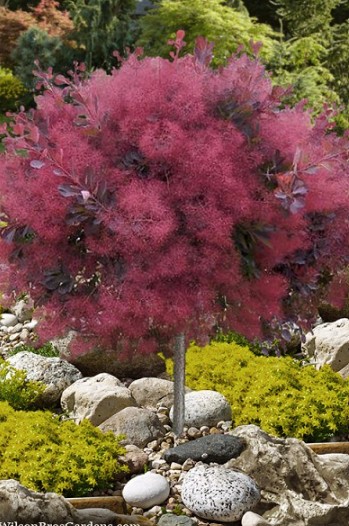
Smoketree

Privacy

Cotinus coggygria ‘Royal Purple’

Deep wine-purple foliage from the day it leafs out until frost, overlaid in summer with airy pink plumes that genuinely read as smoke from a distance. It delivers more colour per day than anything else on this list, because it does not depend on a bloom window — the leaves are the show.

Mature size
10–15 ft tall × 10–12 ft wide
Time to size
6–8 years
Sun
Full sun — the purple washes out in shade
Water
Low; drought tolerant once established
Bloom
Airy pink smoke plumes, June–August
Seasonal interest
Purple foliage all season, summer smoke, scarlet fall
Deer
Rarely damaged
Growth rate
Fast
Hardiness
Zones 4–8
Spacing
Set 12 ft from the house
Maintenance
Low; may be cut hard in late winter for larger leaves
Best use
Colour anchor, informal screen, contrast against green
NoteCutting it hard to a low framework in late winter produces bigger, more saturated leaves but sacrifices that year’s smoke. Pick which effect you want.
Watch outWet feet will kill it faster than cold will. It also reads as a strong contrast — one is a focal point, three in the same view is a lot. Use it deliberately.
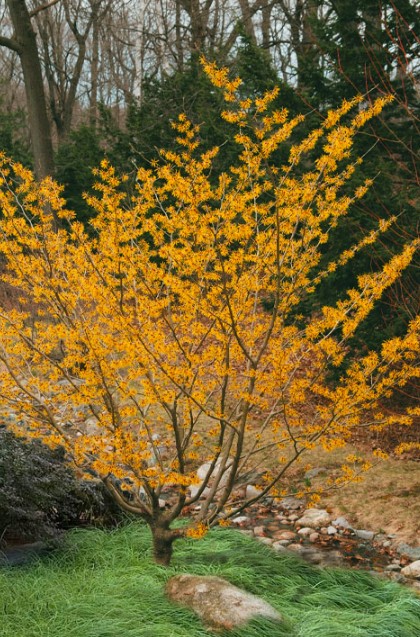
Ozark Witch Hazel in a landscape setting

Ozark Witch Hazel

Missouri native

Hamamelis vernalis

A Missouri native from Ozark streambanks that flowers in the dead of winter — spidery yellow, orange, and red threads that open on bare branches in January and February and carry a clean spicy fragrance on mild days. It closes the one real gap in this planting.

Mature size
6–10 ft tall × 8–12 ft wide
Time to size
6–8 years
Sun
Full sun to part shade
Water
Medium; tolerates moist ground and low spots
Bloom
Fragrant spidery flowers, January–March
Seasonal interest
Deep-winter bloom and scent; clear gold fall foliage
Deer
Rarely damaged
Growth rate
Moderate; suckers at the base
Hardiness
Zones 4–8
Spacing
Set 10 ft from the house
Maintenance
Low; remove suckers if you want a tree form
Best use
Beside a walk or under a window used in winter
NoteNative to Missouri, and the only plant in this entire document that flowers between November and March.
Watch outThe smallest thing in this section — closer to a large multi-stem shrub than a tree — and the individual flowers are small. Its impact comes entirely from the fact that nothing else is blooming. Plant it where you actually pass in January, not at the back of the yard.
Panicle Hydrangea, Tree Form in a landscape setting

Panicle Hydrangea, Tree Form

Hydrangea paniculata ‘Limelight’, grown as a standard

A shrub trained to a single trunk, and the way to have a flowering tree where there is no room for one. Lime-green panicles the size of a forearm open in July, hold through the worst of August when nothing else is doing anything, and age to cream and then rose into October. It is the longest-blooming woody plant in this guide by a wide margin, and unlike the oakleaf it flowers on new wood, so a hard late-winter cut is exactly right.

Mature size
6–8 ft tall × 4–6 ft wide as a standard
Time to size
4–6 years
Sun
Full sun to part shade; six hours for good flowering
Water
Medium to high — the thirstiest plant on this list in July
Bloom
Lime-green panicles July into September, ageing cream then rose
Seasonal interest
Three seasons of bloom; dried heads hold through winter
Deer
Occasionally damaged
Growth rate
Fast — 2 ft per year
Hardiness
Zones 3–8
Spacing
6 ft from anything it should not lean into
Maintenance
Cut back hard in late winter; rub off trunk suckers; stake for two years
Best use
Specimen by a patio or entry, a small tree in a bed with no room for one
Watch outThis is a shape a nursery made, not a tree that grows this way, and it will try to go back. Anything that sprouts below the head is a sucker and must be rubbed off while it is soft, or in three years there is a shrub with a stick in it. The flower heads are heavy and hold water: a summer storm can bend an unstaked young stem permanently, so stake it for the first two seasons and shorten the heads in late winter. It also wilts dramatically in July heat — that is thirst, not death, but it means this one is on the hose.

Plant Display by Month

Solid bars mark the main display — bloom, or fruit where that is the reason to plant it. Pale bars mark the months a plant holds foliage cover, which for the evergreens is all twelve. Read down any column and something is happening. The three additions that close the year are deliberate: winterberry holds red fruit from October into February, Ozark witch hazel flowers in the middle of that stretch, and hardy plumbago carries the tail of autumn.

PlantJFMAMJJASOND
Privacy & Screening
Green Giant Arborvitae
Eastern Red Cedar
Nellie Stevens Holly
Spartan Juniper
Sea Green Juniper
Evergreen Structure
Dwarf Boxwood
Soft Touch Holly
Fire Chief Arborvitae
Blue Globe Spruce
Flowering Shrubs
Virginia Sweetspire
Kodiak Diervilla
Fothergilla
Yuki Cherry Blossom Deutzia
Japanese Spirea
Drift Rose
Russian Sage
Screening & Wildlife Shrubs
Ninebark
Arrowwood Viburnum
Winterberry
Beautyberry
Red Chokeberry
Oakleaf Hydrangea
Ornamental Grasses
Feather Reed Grass
Little Bluestem
Prairie Dropseed
Siberian Iris
Groundcover
Creeping Sedum
Creeping Phlox
Hardy Plumbago
Pennsylvania Sedge
Wild Ginger
Ornamental Trees
Eastern Redbud
Serviceberry
White Fringetree
Kousa Dogwood
Smoketree
Ozark Witch Hazel
Panicle Hydrangea, Tree Form